Who Was Ivan Mykolaichuk?
Ivan Vasylyovych Mykolaichuk was a Ukrainian film actor, screenwriter and director whose short career left one of the deepest marks in the history of Ukrainian cinema. Born on 15 June 1941 in the village of Chortoryia in Bukovyna, in what is now Chernivtsi Oblast, and dying in Kyiv on 3 August 1987 at the age of 46, Mykolaichuk worked for barely more than two decades on screen, yet the films he shaped are still discussed, screened and taught as touchstones of Ukrainian culture. His name is most often linked with two works above all others: Sergei Parajanov’s Shadows of Forgotten Ancestors from 1964, in which he played the Hutsul hero Ivan Paliychuk, and Yuri Ilyenko’s The White Bird Marked with Black, a film he co-wrote and starred in, which won the Gold Prize at the Moscow International Film Festival. Those two films alone would secure a place in film history. Mykolaichuk, however, was not only an actor in other people’s visions. He wrote screenplays, directed two feature films of his own, composed music for film, and built a screen presence that audiences recognised instantly: intense, rooted, watchful, and unmistakably Ukrainian in bearing even when the role itself was historical or mythic. In later years he has often been described as one of the greatest actors in Ukrainian cinematography, a judgement that rests less on the number of his roles than on the weight of a handful of them. His career also unfolded under constant pressure from the Soviet system, which admired his talent and feared the national feeling his work carried. Understanding Mykolaichuk therefore means understanding both an artist and the conditions he worked in: a cinema that could produce extraordinary poetry, and a state that watched that poetry closely for signs of dissent. The images in this article are AI-generated illustrations, labelled as such. Source: Wikipedia records that Mykolaichuk played Ivan Paliychuk in Shadows of Forgotten Ancestors (1964) and co-wrote The White Bird Marked with Black, which won the Gold Prize at the 7th Moscow International Film Festival in 1971.
Early Life in Bukovyna
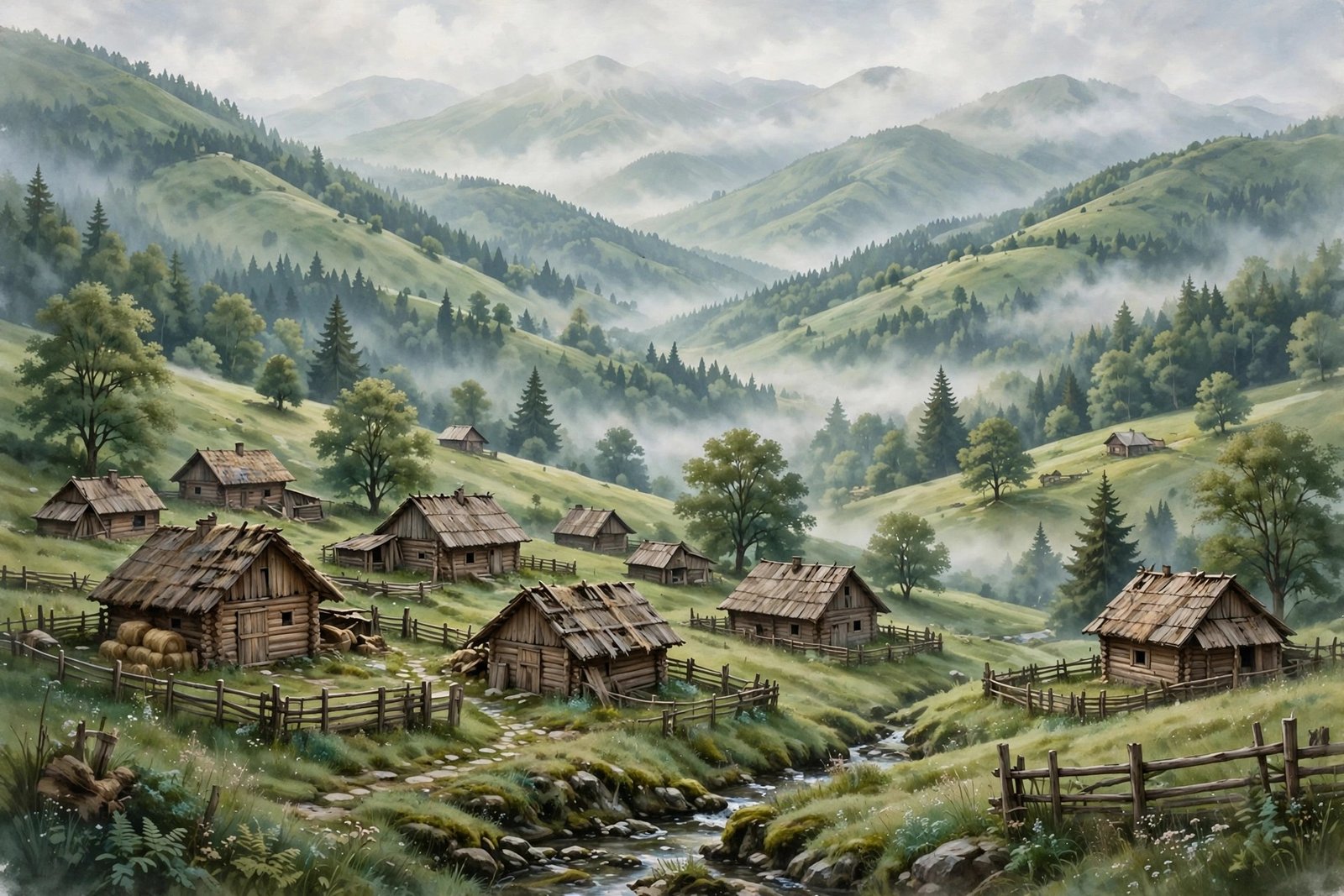
Mykolaichuk was born in Chortoryia, a village in the historic region of Bukovyna, on 15 June 1941, only days before the German invasion of the Soviet Union reshaped the whole region. Bukovyna itself matters to his story because it was a borderland, a place where Ukrainian, Romanian and other traditions met, where village custom, music and ritual were part of everyday life rather than museum pieces. The Hutsul culture of the Carpathians, with its music, dress, wooden churches and mountain way of life, would later become the living material of his most famous roles. Growing up in that world gave him something no drama school could teach: an ear for folk song, a physical ease in village scenes, and a sense of how people in such communities spoke, moved and held themselves. His formal training began early. In 1957 he completed drama studies at the Chernivtsi Ukrainian Music and Drama Theater, a regional theatre with a strong Ukrainian repertoire. That step took him from a village upbringing into professional performance while keeping him close to the theatrical traditions of western Ukraine. He then moved to Kyiv and in 1965 graduated from the Kyiv Institute of Theater Arts, the leading training ground for Ukrainian actors and directors. From 1965 he worked at the Kyiv Artistic Film Studio, known as the Dovzhenko Film Studio, which was the centre of Ukrainian feature filmmaking. The timing mattered. The mid-1960s were a period of relative cultural opening in Soviet Ukraine, when a new generation of filmmakers was pushing for a cinema rooted in Ukrainian literature, landscape and history. Mykolaichuk arrived at exactly that moment, trained, ambitious, and already formed by the culture he would soon embody on screen.
The Breakthrough: Shadows of Forgotten Ancestors
Mykolaichuk’s breakthrough came in 1964, when he was still a young actor, with two films released in the same year that pointed in different directions. The first was The Dream, based on Taras Shevchenko’s poem and directed by Volodymyr Denysenko, in which Mykolaichuk played the young Shevchenko himself, a casting choice that already signalled how seriously the studio took him. The second, and far more famous, was Shadows of Forgotten Ancestors, directed by Sergei Parajanov and based on the novella by Mykhailo Kotsiubynsky. Mykolaichuk played Ivan Paliychuk, a Hutsul man whose life is shaped by a childhood love, a family feud, grief and the harsh beauty of the Carpathian mountains. The film became an international landmark, celebrated for its colour, its camera work and its immersion in Hutsul ritual, from weddings and funerals to music and seasonal custom. For Mykolaichuk, the role was both a gift and a definition. His Ivan is not a polished hero but a man of feeling, stubborn and tender by turns, and the performance carries the film’s emotional centre through long stretches where dialogue gives way to image and music. The film also drew the attention of the authorities. Everyone who worked on Shadows of Forgotten Ancestors came under special scrutiny, and Mykolaichuk was no exception, a pattern that would follow him for the rest of his career. Yet the artistic result could not be undone. The film put Ukrainian poetic cinema on the world map, and it made Mykolaichuk, in his early twenties, the face of that movement. For audiences discovering Ukrainian cinema today, Shadows of Forgotten Ancestors remains the natural starting point, and Mykolaichuk’s performance remains the reason the film feels human rather than merely beautiful.
The Dream and the Young Shevchenko
Playing Taras Shevchenko, Ukraine’s national poet, in The Dream in 1964 was a remarkable assignment for an actor so young, and it reveals how Mykolaichuk was seen inside the Ukrainian film world. Shevchenko is not simply a historical figure in Ukrainian culture; he is a symbol of the nation itself, a poet whose words about freedom and dignity are known across generations. To cast a newcomer in that role was to say that he carried a certain gravity, a seriousness that audiences would accept in such a part. The film was based on Shevchenko’s poem, and Mykolaichuk’s portrayal was one of the performances later cited when he received the Shevchenko State Prize posthumously in 1988, alongside his roles in Shadows of Forgotten Ancestors, The Viper or Wild Grass, Commissars, White Bird with Black Mark, Babylon XX and Such a Late, Such a Warm Autumn. The citation itself is a useful map of his career, because it gathers roles from across two decades and treats them as a single body of work. The young Shevchenko and the Hutsul Ivan Paliychuk, made in the same year, show the two poles of his early screen identity: the national icon and the village man, both played without theatrical exaggeration. Mykolaichuk’s acting style was realistic and intense rather than showy. He followed the aesthetic traditions of Oleksander Dovzhenko, the great Ukrainian director whose name the Kyiv studio bore, in giving grounded, deeply felt portrayals of archetypal and historical characters. That approach suited both Shevchenko and Paliychuk, and it would remain his signature even as his roles grew more varied.
The White Bird Marked with Black
The White Bird Marked with Black, known in Ukrainian as Bilyi ptakh z chornoiu oznakoiu, is the film most closely tied to Mykolaichuk’s name after Shadows of Forgotten Ancestors, and it is the work where his roles as actor and writer came together. Directed by Yuri Ilyenko and co-written by Ilyenko and Mykolaichuk, the film was released in 1971 and entered into the 7th Moscow International Film Festival, where it won the Golden Prize. Mykolaichuk played Petro Dzvonar, one of the sons of a poor family of musicians in a Hutsul village in northern Bukovyna. The story follows the Zvonar family between 1937 and 1947, as the borderland is pulled between Romanian rule, Soviet rule and war. Petro and his brother Orest, played by Bohdan Stupka, are both in love with Dana, the priest’s daughter, and the brothers’ choices divide them: Petro joins the Red Army, while Orest goes to the mountains and joins the Ukrainian nationalist insurgents. The film’s plot is tragic and unsparing, ending with the deaths of Petro and Ostap, the Red Army officer Dana marries, and with Orest cornered at a wedding. Behind that plot, however, lies the film’s deeper subject: a family and a village torn apart by forces larger than any of its members, and a folk parable about a white bird marked with black that gives the film its title. Mykolaichuk also contributed music to the film, a reminder that his artistry extended beyond acting and writing. The film drew large audiences, with one account recording 10.5 million admissions across the Soviet Union, and it confirmed his standing as a creative force, not merely a performer. At the same time, despite its international recognition, the film became another reason for the authorities to accuse him of nationalism, and his professional path grew harder from that point on.
A Working Actor Through the 1970s
Beyond his two landmark films, Mykolaichuk built a long and varied filmography through the late 1960s and 1970s, and that body of work shows an actor willing to move between genres. In 1968 alone he appeared in The Scouts as Viktor Kurhanov, The Stone Cross as Mykola, Mistake of Honoré de Balzac as Levko, and Annychka as Roman. It was during the production of Annychka that he was first accused of nationalism, with an official complaint filed against him and a label of being ideologically hostile attached to his name, a charge he answered by insisting that he was simply a patriot. That episode set a pattern: celebrated abroad and watched at home, with each new success bringing fresh obstacles. In 1971, the same year as White Bird, he played Liubomyr in Zakhar Berkut, directed by Leonid Osyka, and Hryhoriy Hromov in Commissars. In 1972 he played the Cossack Vasyl in The Lost Letter, a film that has kept a popular following for its humour and folk energy. Later roles included Gnat in The Troubled Month of Veresen in 1977, Rusyn in Atonement for Others’ Sins in 1978, and Simokhyn in The Sea in 1978. These were not all leading parts, and some were smaller character roles, but together they show a working actor embedded in the Ukrainian studio system, moving from historical epics to contemporary stories and literary adaptations. He also worked as a writer during these years, with credits including To Dream and to Live in 1974, directed by Ilyenko from his script, The Unsociable Man in 1977, and Under the Constellation Gemini in 1978. For a modern viewer, this middle period is the best evidence that Mykolaichuk was not a two-film actor. He was a constant presence in Ukrainian cinema for two decades, and his face became familiar to audiences across the Soviet Union even when the films themselves were not allowed the freedom he wanted for them.
Babylon XX and the Move to Directing
Mykolaichuk’s move into directing was the natural next step for an artist who had already been writing and shaping films from inside the cast. His first feature as director was Babylon XX, released in 1979 and based on a novel by Vasyl Zemliak, in which he also played Fabian. The film won the Best Director prize at the All-Union Film Festival in Dushanbe in 1980, a recognition that confirmed his talent behind the camera as well as in front of it. Permission to make the film had itself been hard won, coming only after intervention on his behalf, which underlines how closely his projects were watched. His second and final feature as director was Such a Late, Such a Warm Autumn, released in 1981 and written with Vitalii Korotych, in which he played Hryhor Korchak. Both films carry the marks of his artistic identity: a concern with Ukrainian village life, with history as lived experience rather than official narrative, and with characters who are ordinary people caught in extraordinary times. Directing also gave him a different kind of control. As an actor he could shape a single performance; as a director he could shape the whole world of a film, its rhythm, its landscape and its music. That he managed to complete two features under the conditions of the late Soviet period, when his reputation with the authorities was already damaged, is itself a measure of his determination and of the respect he commanded among colleagues. His later acting roles continued alongside his directing, including the Forest Song adaptation in 1981, in which he played Uncle Leo and the spirit of the forest, The Return of Butterfly in 1982 as Anton Krushelnytsky, and The Legend of Princess Olga in 1984 as Prince Volodymyr. His final screen role was Pavlo Zhmenyak in the television mini-series Handfuls in 1987, the year of his death.
Pressure, Restriction and Reputation
The political pressure that shaped his career explains both what he achieved and what he was prevented from achieving. From the mid-1960s onward, Ukrainian culture, language and self-expression were treated with suspicion by the Soviet authorities, and artists who gave those things vivid form were liable to be called nationalists. Mykolaichuk’s work did exactly that: it presented Ukrainian village life, folk custom and historical memory with pride and without apology. After Shadows of Forgotten Ancestors, the scrutiny intensified. After Annychka came the first formal accusation. After White Bird Marked with Black, despite its Moscow festival prize, came further obstacles in his professional life. Projects were delayed, scripts were questioned, and roles that might have gone to him went elsewhere. This was not a single dramatic ban but a slow narrowing of possibilities, the kind of pressure that wears an artist down over years. Mykolaichuk was not a political dissident in the organised sense, and his films were made inside the Soviet studio system. His offence, in the eyes of the authorities, was cultural rather than conspiratorial. He insisted on a Ukrainian screen identity at a time when that identity was supposed to remain decorative. That is why his legacy has grown rather than faded since independence. Audiences and filmmakers in modern Ukraine see in him an artist who kept faith with his culture under conditions designed to discourage exactly that, and who paid a professional price for it. His house in his native Chortoryia has since been turned into a museum, a quiet but telling recognition of what he means to the place he came from.
Awards, Death and Lasting Legacy
Mykolaichuk received significant official honours during his lifetime, even as his relationship with the authorities remained difficult. He won the Lenin Komsomol Prize of Ukraine in 1967, following Shadows of Forgotten Ancestors, and was named a Meritorious Artist, also translated as Distinguished Artist, of the Ukrainian SSR in 1968. After his death he received the Shevchenko State Prize of the Ukrainian SSR posthumously in 1988, for the group of roles listed earlier, from the young Shevchenko through to Hryhor Korchak. That posthumous prize is a fitting summary of a career that was recognised in full only after it ended. He died in Kyiv on 3 August 1987, at 46, leaving behind a body of work that was incomplete in the ordinary sense: more films unwritten, more roles unplayed, more directing projects unrealised. Yet the films that do exist have proved durable. Shadows of Forgotten Ancestors is still the international calling card of Ukrainian cinema. White Bird Marked with Black is still screened and studied as a landmark of poetic cinema. Babylon XX and Such a Late, Such a Warm Autumn are still cited by filmmakers who value his directing. A book of memoirs about him, interviews with him and his scenarios was published in Kyiv in 1991, helping a new generation to encounter the artist in his own words and plans. For readers new to Ukrainian film, Mykolaichuk offers a clear entry point: start with Shadows of Forgotten Ancestors for the poetry, watch White Bird Marked with Black for the history and the tragedy, and then explore Babylon XX to see what he wanted to say as a director. Taken together, those three films explain why his name still carries such weight, and why a career cut short at 46 continues to shape how Ukraine sees itself on screen.
Frequently Asked Questions
When was Ivan Mykolaichuk born and when did he die?
Ivan Mykolaichuk was born on 15 June 1941 in Chortoryia, Bukovyna, and died on 3 August 1987 in Kyiv at the age of 46.
What is Ivan Mykolaichuk best known for?
He is best known for playing Ivan Paliychuk in Shadows of Forgotten Ancestors (1964) and for co-writing and starring as Petro Dzvonar in The White Bird Marked with Black (1971).
Did Ivan Mykolaichuk direct films?
Yes. He directed Babylon XX (1979), in which he also played Fabian, and Such a Late, Such a Warm Autumn (1981), in which he played Hryhor Korchak.
What awards did Ivan Mykolaichuk win?
He won the Lenin Komsomol Prize of Ukraine in 1967, was named a Meritorious Artist of the Ukrainian SSR in 1968, and received the Shevchenko State Prize posthumously in 1988.
Why did the Soviet authorities watch Ivan Mykolaichuk closely?
His films presented Ukrainian village life, folk culture and historical memory with pride, and he was accused of nationalism, first during Annychka and again after White Bird Marked with Black, which brought professional obstacles.
Where did Ivan Mykolaichuk study acting?
He completed drama studies at the Chernivtsi Ukrainian Music and Drama Theater in 1957 and graduated from the Kyiv Institute of Theater Arts in 1965, then worked at the Kyiv Artistic Film Studio.
What should a new viewer watch first?
Start with Shadows of Forgotten Ancestors for his breakthrough performance, then The White Bird Marked with Black for his work as writer and actor, and Babylon XX to see his directing.