Anita Lutsenko: The Trainer Who Turned Fitness Television Into Everyday Coaching
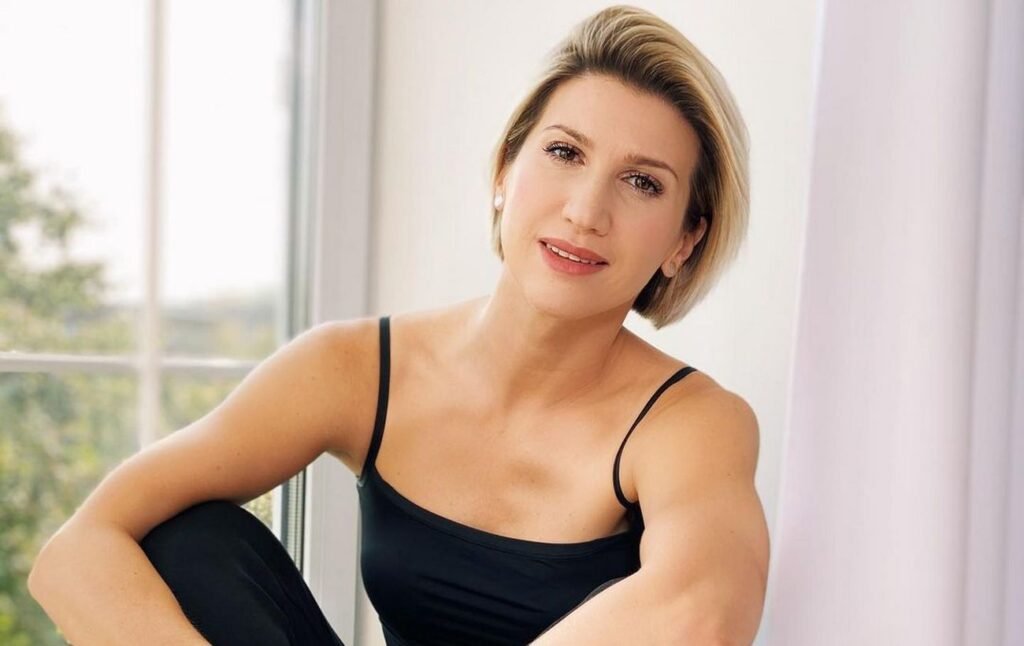
Anita Lutsenko is best known in Ukraine as a fitness trainer who became a television coach, and then as an online coach whose programmes, books and social media advice reach people far beyond a television studio. Her career is different from a typical influencer story because it did not start with social media. It started with sport: rhythmic gymnastics as a child, competitive sports aerobics as a teenager, a university education in physical education and sport, and more than a decade of teaching fitness before she became a household name on television. That sporting base is why her online influence has lasted. When she talks about weight loss, strength, stretching or daily habits, she is not repeating a trend she discovered online. She is drawing on qualifications, competitive experience and years of coaching real people in gyms, at conventions and on a weight-loss television format. Medical disclaimer: this article describes Lutsenko’s public coaching advice for general information only. It is not medical advice, and it does not replace advice from a qualified doctor or other health professional. Readers should consult a health professional before starting a new diet or exercise programme, especially if they have a health condition, are taking medication, or are pregnant. The images in this article are AI-generated illustrations, labelled as such. 1. Early Life and Childhood Sport in Kyiv Anita Lutsenko was born on 11 March 1984 in Kyiv. She began rhythmic gymnastics at the age of four, studying at the school associated with Irina Deryugina, a name closely linked to Ukrainian rhythmic gymnastics. Starting sport that young shapes a child’s daily life in a specific way: regular training, discipline about the body, an early understanding of flexibility, coordination and performance under observation. She also studied aerobics and dance professionally as she grew older. That combination, gymnastics plus aerobics plus dance, later became the core of her fitness teaching. She did not specialise narrowly in one movement style. She learned to move, to teach movement, and to adapt movement for people with different abilities, a skill that matters far more in weight-loss coaching than the ability to perform a difficult routine oneself. Her childhood sport also explains her later emphasis on sustainability. A child who trains for years learns that the body responds to consistent work, not to a single extreme week. That lesson appears again and again in her adult coaching: small, repeatable habits, rather than crash approaches, are presented as the route to lasting change. 2. Competitive Years: Sports Aerobics and a Master of Sports Title From 1994 to 2002, Lutsenko took part in Ukrainian and European championships in sports aerobics, with earlier biographical summaries also noting participation in championships at city, national and European level. Under the guidance of coaches Olga Pasechna and Sergey Zika, according to a trainer profile, she achieved the title of Master of Sports in sports aerobics. She won a silver medal at the European Championship in sports aerobics, and won many times at the championship of Ukraine in aerobics and fitness. Those competitive results are important for two reasons. First, they establish that her authority as a trainer rests on judged, competitive performance, not only on television presence. Second, they explain her coaching range: sports aerobics combines strength, flexibility, rhythm and endurance, and a competitor in that discipline must train all of them. When she later taught step, aerobics, dance, strength, functional training, Pilates, stretching and aqua-aerobics, she was drawing on a broad competitive and teaching base, not learning each format from scratch for television. The competitive period also ended at a useful point for her teaching career. By the early 2000s, she was moving from competing herself to teaching others, a transition many athletes make, but one that requires a different skill: explaining a movement so that a beginner can do it safely, rather than performing it perfectly oneself. 3. University Education and Qualifications Lutsenko received her higher education at the National University of Physical Education and Sport in Ukraine. She earned a bachelor’s degree with honours in Olympic professional sport, and a master’s degree with honours in the theory and methodology of organisation of sports events and spectacles. Those degree titles, reported in biographical sources, matter because they show formal training in both sport performance and in how sporting activity is organised and presented. She also holds qualifications as a fitness trainer and physical education teacher, and she is a certified Pilates and TRX specialist. TRX, short for Total Resistance Exercises, uses suspension straps for body-weight training, and Pilates focuses on core strength, control and flexibility. Listing those specialisms is not a formality. It explains why her later programmes could include home workouts, studio classes, functional training and stretching, rather than only one style of exercise. Her teaching career began early. She first started teaching fitness in 2000, while still building her own competitive and university path. From 2008, she was a teacher at SFC, the training centre of the Sofia club, according to a trainer profile, and she worked with a number of fitness clubs and venues, including open and charitable classes. That long teaching period before television fame is the foundation of her later credibility: she had already taught hundreds of people before a camera made her famous. 4. Nike Conventions and Becoming a Presenter of Functional Training Before her television breakthrough, Lutsenko acted as a presenter in functional training at regional and international Nike conventions in Ukrainian cities, including Kyiv in 2006 to 2008, Odesa in 2006, Donetsk and Dnipropetrovsk. Convention presenting is a demanding, practical form of teaching. A presenter must lead a large room, keep timing, demonstrate clearly, correct form from a distance, and hold energy across a session. That experience helps explain why she adapted well to television. A television weight-loss show also requires leading a group, explaining a task clearly, and maintaining authority without shouting. Convention work had already taught her to do that for live audiences who could see every mistake. Television added cameras, but the core […]
Anita Lutsenko: The Trainer Who Turned Fitness Television Into Everyday Coaching Read Post »