Yevhen Klopotenko is a Ukrainian chef who turned cooking into a public cause. He won MasterChef Ukraine in 2015, opened a Kyiv restaurant built around pre-Soviet recipes, campaigned for borshch at UNESCO, and rewrote school meals across Ukraine. As of November 2026, this page follows that career in order, from a self-taught cook to the country’s best-known food campaigner.
Quick facts
| Name | Yevhen Viktorovych Klopotenko |
| Born | 23 November 1986, Kyiv |
| Known for | MasterChef Ukraine, school meals reform, borshch at UNESCO |
| Main works | 100 Rokiv Tomu Vpered, Cult Food, Odyssey, klopotenko.com |
A winding road into the kitchen
Klopotenko was born in Kyiv on 23 November 1986, when Ukraine was still part of the Soviet Union. His parents taught him to cook borshch and scrambled eggs, and those early lessons gave him his first interest in developing recipes. In 1991 he spent time living with his grandmother in England, near Manchester, where he encountered a wider range of food than he had known at home.
He did not go straight from school into a kitchen career. He studied international relations at the Kyiv University of Economics and Law, worked at a Mexican restaurant in the United States, at a McDonald’s franchise in Germany on a university programme, and at various restaurants in Kyiv. Before becoming a professional chef, he sold homemade jam. He also travelled to Italy and developed an interest in Italian cooking, and watching Gordon Ramsay’s Kitchen Nightmares helped inspire him to become a chef.
By his own early description, he was a keen home cook who cooked for pleasure, not a graduate of a culinary school working his way up a brigade. That background matters when his later work is judged, because his authority rests on research, on television exposure, on formal study undertaken after he was already known, and on a willingness to test old recipes in public until they worked.
MasterChef Ukraine and Le Cordon Bleu
Klopotenko’s breakthrough came in 2015, when he won season five of MasterChef Ukraine. The competition format mattered as much as the victory. MasterChef is a televised contest in which contestants must cook under time pressure, present food to judges, and hold an audience’s attention while doing it. Winning it gave him a professional credential in the eyes of the public, and a television performer’s profile. He spent a long stretch living in a hotel during the competition as he advanced through its stages, an experience he later described as demanding in a way that had little to do with cooking.
The prize and the exposure that followed allowed him to do what his self-taught beginnings had not: study formally. In 2016 he graduated from Le Cordon Bleu in Paris. The sequence reverses the usual order. Most chefs train first and become known later. Klopotenko became known first, through a television audience, and then went to Paris to acquire the technique that would let him do more with the ideas he already had.
On his return to Ukraine he gave online cooking courses and was hired as a brand chef for several Kyiv restaurants, developing menus and teaching house chefs how to prepare them. That work, moving between kitchens rather than staying in one, taught him how a recipe travels: it must be written clearly enough for another cook to follow, strong enough to survive a busy service, and distinctive enough to be worth cooking in the first place.
Television also gave him a second career as a presenter of food as history. He created a television series called Odyssey, which presented Ukrainian culinary traditions through historical figures and ran for three seasons. A dish is introduced through the person who might have eaten it, the place it came from, and the occasion it belonged to, which makes the history memorable in a way a textbook entry is not. That storytelling instinct later shapes his books, his restaurant menus and his online videos alike.
Discovering a cuisine he had not been taught
The turning point in Klopotenko’s cooking came after MasterChef, when he confronted a gap in his own knowledge. Asked to name Ukrainian dishes, he could quickly list borshch, varenyky, pampushky and salo, and then he stalled. Beyond those famous dishes, he realised, most Ukrainians ate food introduced during the Soviet era, and the older repertoire had faded from everyday cooking.
From around 2017, as he thought about opening a restaurant, he began to research pre-Soviet Ukrainian cooking seriously. He worked with historians and read Ukrainian literary manuscripts for references to food, including Ivan Kotliarevsky’s Eneida, Practical Kitchen by Olha Franko, and the 1913 book Food and Drink of Ukraine, written by several authors under the pseudonym Zinaida Klynovetska. He travelled around Ukraine to learn about regional cuisines, because Ukrainian cooking is not one uniform tradition: the Carpathians, Poltava, Odesa, Volhynia and the east each have dishes shaped by geography, trade and neighbouring cultures.
This research produced a distinctive cooking philosophy. Klopotenko does not argue that Ukrainian food should be preserved exactly as it was a century ago, untouched. He argues that it should be recovered and cooked in a modern way, with contemporary technique and presentation, so that it can live in a present-day restaurant rather than a folklore display. A dish such as banosh, a corn porridge from the Carpathians, can be served with cottage cheese, mushrooms and apples in a way that people today recognise as Ukrainian, while still carrying the flavours and ingredients of its place of origin. Roasted parsnips with smoked sour cream, buckwheat bread flavoured with chamomile, and borshch seasoned with smoked pears all work the same way.
Editor’s take: the research matters more than the restaurant. A chef can open a fashionable room and fill it for a year. Recovering a cuisine that had been flattened into four dishes, and then cooking it in a way that stands up in a modern kitchen, is a longer job, and it is the job that explains everything else Klopotenko did afterwards.
100 Rokiv Tomu Vpered, a restaurant as an argument
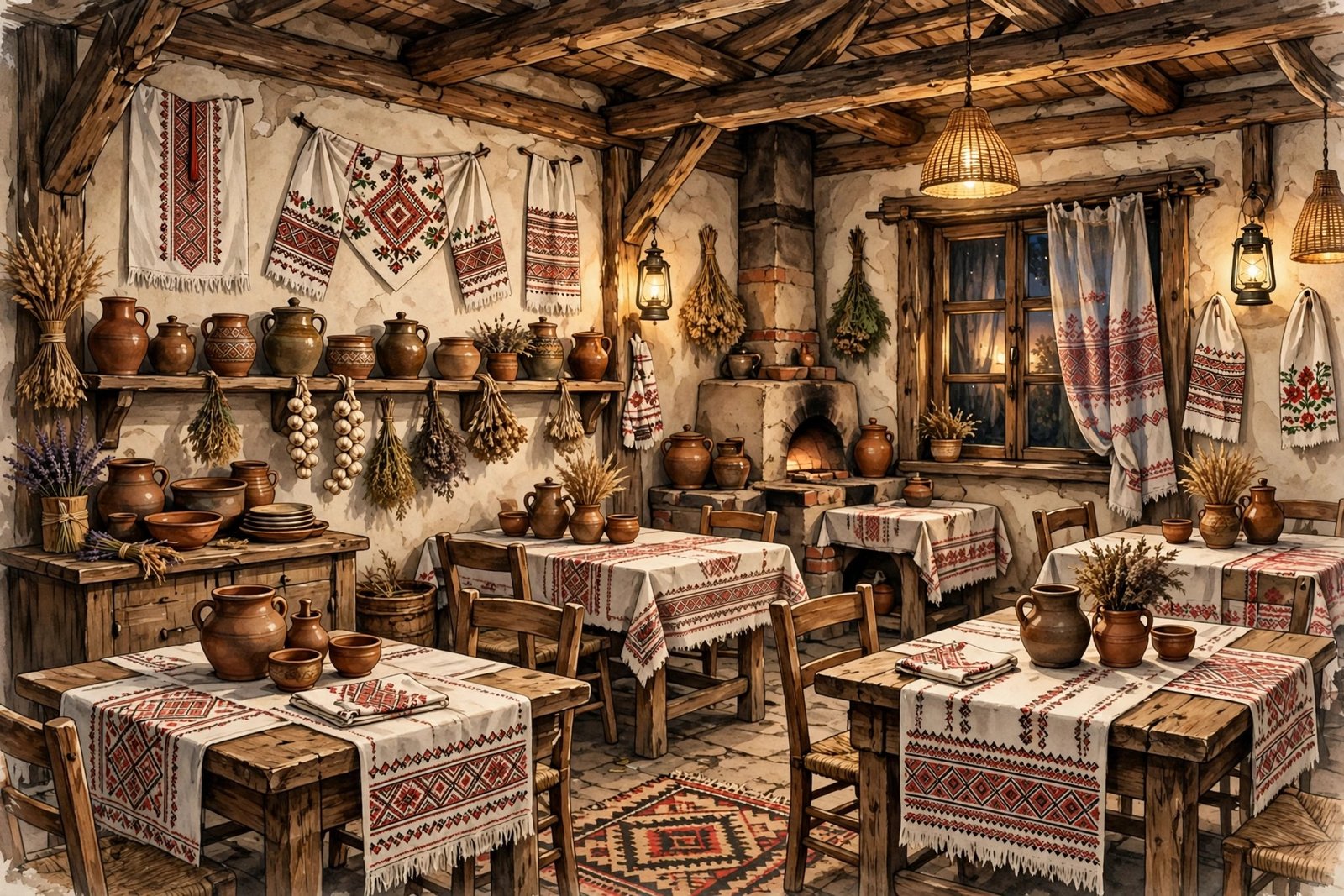
In March 2019, Klopotenko opened 100 Rokiv Tomu Vpered in central Kyiv, in cooperation with Inna Poperezhnyuk, a co-founder of the delivery company Nova Poshta. The name translates roughly as 100 Years Back to the Future, or 100 Years Ago Ahead, and it states the restaurant’s idea in a single phrase: what would Ukrainian cuisine look like today if the Soviet period had not interrupted it? The menu draws heavily on flavours and ingredients many Ukrainians had forgotten, and its ingredients are locally sourced.
The restaurant is presented as a modern form of that cuisine rather than a reconstruction for tourists. Reporting on the restaurant has lingered on its most surprising dishes, including fried honey bees, once believed to have medicinal properties, and catfish served with beet sauce, as well as huslyanka, a Carpathian soured milk product whose local bacteria, Klopotenko argues, make it distinct from its Greek or Turkish counterparts. Whether a visitor orders those particular dishes, the point of the menu is the same: Ukrainian cuisine contains far more than the handful of dishes that survived Soviet standardisation, and a modern kitchen can serve that wider repertoire without turning it into a costume drama.
The restaurant also became a stage for culinary diplomacy. In 2024, during an official visit to Kyiv, the United States Secretary of State Antony Blinken dined at 100 Rokiv Tomu Vpered, and Klopotenko told him, in a line widely quoted afterwards, that his life would be divided into two parts: before he tried the chef’s borshch and after he tried it. The anecdote is often told as a joke, but it captures something real about Klopotenko’s method. He treats a meal with a visiting dignitary as a form of communication: a chance to make a political point through flavour rather than through a briefing paper. He gives a visitor a direct, sensory experience of Ukrainian identity that no briefing paper can provide.
Wartime kitchens and cooking for diplomats
When Russia launched its full-scale invasion of Ukraine in February 2022, Klopotenko’s restaurants changed function almost overnight. 100 Rokiv Tomu Vpered closed for two days, then reopened as a military canteen, and by April 2022 it was producing 1000 meals a day. In wartime, a restaurant becomes infrastructure: a kitchen with staff, suppliers and equipment can feed soldiers and displaced people far more quickly than a new charity can be built from scratch.
In March 2022 Klopotenko opened a second establishment, a pop-up bistro in Lviv called Inshi, meaning Others, together with Iryna. Lviv, in western Ukraine, was receiving large numbers of people fleeing the fighting, and Klopotenko acquired a former cafe building and opened the restaurant five days later. Inshi had two menus: the main menu, and a second menu, listed as menu two, which people could order free of charge. The free menu was funded by paying customers, donations and Klopotenko’s own money, and the restaurant deliberately avoided referring to its customers as refugees. A person who has fled their home is not defined by that flight: they are a customer like any other, who happens to be eating from a different menu.
The wartime work extended beyond his own restaurants. In April 2022 he began catering for diplomats and other visitors travelling on the national rail service, Ukrzaliznytsia, in an effort to win political support for Ukraine. The first such guest he served was Boris Johnson, then the British prime minister, whose identity was kept secret from the crew in advance. Later guests included the German chancellor Olaf Scholz and the musician Bono. In November 2022 he hosted dinners in the United Kingdom to raise money for the victims of the war. These projects are best understood as an extension of the Blinken dinner: Klopotenko cooks for people whose decisions matter, and he uses the meal to make Ukraine’s case in a register that a press release is not.
A later venture in the same spirit is Muza, a ready-meal delivery service co-founded by Klopotenko, which presents itself as restaurant-quality Ukrainian cuisine for eating at home. Reporting on its expansion describes a menu of more than thirty traditional Ukrainian dishes, including borshch with smoked pear, bograch, varenyky, meat and fish cutlets, a Poltava-style cutlet, breakfasts, desserts and signature fruit compotes and drinks. The service has expanded through a franchise model to several Ukrainian cities. Its significance is that it carries the same idea as the Kyiv restaurant into everyday life: Ukrainian food is not only for a special evening out, but for an ordinary weekday dinner, in a home kitchen.
Cult Food and the school meals reform
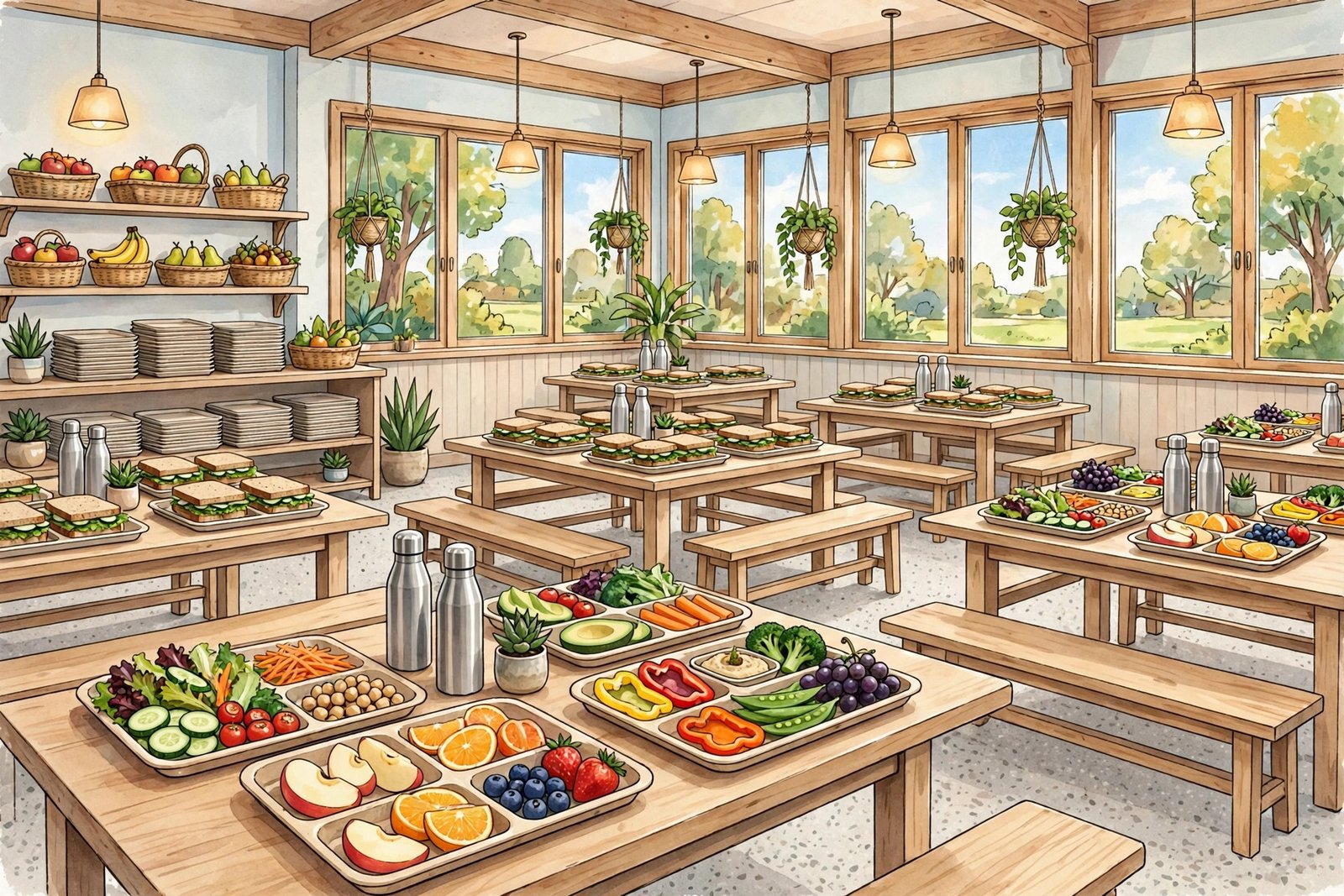
If the restaurant made Klopotenko a chef, the school meals reform made him a public figure in every Ukrainian household with a child. In 2016 he launched a project called Cult Food, through which he worked on improving nutrition in Ukrainian educational establishments and reforming professional culinary education. In 2018 he wrote a meal manual of 110 new recipes for school canteens, which was adopted at government level. The scale was striking: a chef’s recipe collection became, in effect, a piece of national infrastructure. By the beginning of 2020 more than 5000 schools across the country were using the new approach.
The background to the reform explains why it was needed. Ukraine’s school meals had been governed by Soviet-era regulations dating back to the 1950s, which forbade spices besides black pepper and produced a narrow, repetitive diet. Klopotenko’s team, working with specialists from the Ministry of Health, dieticians and the Ministry of Education, developed a new approach with less sugar, less salt and fewer fats, more fresh vegetables, meat and fish, and no artificial additives. Alongside the school work, Klopotenko signed a memorandum of cooperation with the Ministry of Education and Science on a culture of healthy eating in educational institutions, with provisions for professional training in culinary schools and work with children and their parents.
The reform was also controversial. Parents protested, children complained, and public discussion was heated at times. That is worth remembering when the reform is described as a success: a change to what five thousand schools serve for lunch will always meet resistance, from children who liked the old food, from parents who worried about the new food, and from canteen staff who had to learn new recipes. A reform that survives that resistance is different from a reform that is simply announced.
Where to start
New readers do best starting with the borshch at 100 Rokiv Tomu Vpered, or with Klopotenko’s borshch recipe on his website, because borshch is the dish that ties the restaurant, the UNESCO campaign and the school work together, and the smoked-pear version shows how far from a standard canteen soup it can go. Next comes banosh, the Carpathian corn porridge with cottage cheese, mushrooms and apples; it is the clearest example of a regional dish that had been lost to most Ukrainians and then brought back. A school canteen meal, as reformed under Cult Food, rounds out the set; it is the least glamorous of the three, and that is the point, since it is the work that reached the most people.
Frequently asked questions
Who is Yevhen Klopotenko?
Yevhen Klopotenko is a Ukrainian chef, restaurateur, cookbook author and food campaigner, born in Kyiv on 23 November 1986. He won MasterChef Ukraine in 2015 and is best known for the restaurant 100 Rokiv Tomu Vpered, the school meals reform, and the campaign for borshch at UNESCO.
What is 100 Rokiv Tomu Vpered?
It is Klopotenko’s Kyiv restaurant, opened in March 2019 with Inna Poperezhnyuk. Its name means roughly 100 years back to the future, and its menu is built around pre-Soviet Ukrainian recipes cooked in a modern way.
What did Klopotenko do for school meals in Ukraine?
Through his Cult Food project, launched in 2016, he developed new school canteen recipes and a four-week meal plan. In 2018 he wrote a meal manual of 110 new recipes, which was adopted at government level, and by the beginning of 2020 more than 5000 schools were using the new approach.
Why is Klopotenko associated with borshch and UNESCO?
He travelled across Ukraine documenting regional borshch recipes and, with Maryna Sobotiuk, prepared the nomination for UNESCO. On 1 July 2022 UNESCO inscribed the culture of Ukrainian borshch cooking on its List of Intangible Cultural Heritage in Need of Urgent Safeguarding.
Sources
- Wikipedia — Yevhen Klopotenko
- Klopotenko — official site
- UNESCO — Intangible Cultural Heritage (official site)