Osadcha’s career began far from a television studio, on modelling runways and photo shoots abroad, and settled into one of the most recognisable presenting jobs in Ukraine. Born in Kyiv in 1983, Osadcha spent her teenage years working as a model in Japan and Western Europe, returned home at eighteen, retrained her voice and her professional direction, and then built a long television life around two very different kinds of programme: the society interview show Social Life and the singing competition Holos Krainy, known in English as The Voice of Ukraine. She is a presenter, not a coach or a judge on Holos Krainy. Coaches choose and mentor singers; Osadcha holds the live show together, introduces performers, speaks to coaches and contestants, and gives the audience a steady point of contact as the competition moves from auditions to the final. Alongside that flagship role, she has presented the children’s version of the format, served as a jury member on a modelling competition, co-hosted a major charity telethon, and put her name to foundation work aimed at helping teenagers think seriously about their future professions.
Kateryna Osadcha Biography: Early Life in Kyiv
Kateryna Osadcha was born on 12 September 1983 in Kyiv. Her father, Oleksandr Osadchyi, was the director of the Kyivprylad factory, and her mother was a homemaker. She also has a younger brother. The family background, as described in published biographical accounts, was comfortable and industrious rather than show-business connected, and her earliest public activities were not in front of a camera at all. At school she took music lessons and danced, becoming a member of the choreographic ensemble known as Little Falcons. That combination of music and movement would later look like an early rehearsal for a career spent on stages and in studios, but at the time it was simply the extracurricular life of a Kyiv schoolgirl with energy, discipline and an interest in performance.
Her schooling itself was interrupted, and eventually reshaped, by work. Modelling arrived early and demanded travel, long days and time away from the classroom. Osadcha therefore completed her final school examinations externally, a practical solution that allowed her to keep working while still finishing her education. She did not drift into modelling as an adult after university; she entered it as a teenager and had to organise her education around it. The same practical approach shaped a later decision: when she returned to Ukraine and moved towards journalism, she studied in absentia at the Faculty of History of the University of Kyiv, fitting academic study around adult work and family life rather than following a conventional full-time student path.
From Kyiv to Tokyo: The Modelling Years, Ages Thirteen to Eighteen
Osadcha began her professional modelling career at thirteen, after graduating from the Bagira Agency’s modelling school in Kyiv. At fourteen, having just finished ninth grade, she travelled to Tokyo for three months of filming and photo work. Later assignments took her to Germany, England and France. She was not working only in one market or one fashion capital, but moving between countries, languages and production teams while still a teenager. That experience gave her a working familiarity with cameras, directors, styling and the pace of a shoot, and it also gave her an early lesson in adaptability: a model on location must understand instructions quickly, present herself consistently, and remain composed under pressure.

By eighteen, however, she had decided that modelling would not be her adult career. She finished her modelling work and returned to live in Ukraine. The decision is often presented as a clean break, but in practice the skills carried over. A presenter, like a model, works to camera, understands framing and timing, and must be comfortable being looked at while doing a job. What changed was the substance of the work. Instead of embodying someone else’s visual idea for a shoot, she would have to ask questions, listen to answers, hold a conversation and carry information to an audience. That shift from image to language is the central turn in her biography, and the next phase of her life was spent making it possible.
A New Voice: Language Training, Motherhood and a History Degree
Osadcha’s return to Ukraine coincided with major personal change. Four months after the birth of her first child, she began working with a teacher to practise speech and diction, because her knowledge of the Ukrainian language was, by her own account in biographical sources, not strong enough for the broadcasting career she wanted. That runs against a common assumption that a successful presenter must have started out fluent and confident in the broadcast language. In Osadcha’s case, fluency was built deliberately, through tuition, after she had already become a mother and after she had spent formative years working largely outside Ukraine.
Her journalism education followed a similarly practical route. She graduated in absentia from the Faculty of History of the University of Kyiv, a background that gave her a general humanities education rather than a narrow vocational media degree. Her first experience of television journalism came as a freelance correspondent for the First National Channel, which was renamed UA:First in 2015. Freelance correspondence is unglamorous, foundational work: researching stories, making contacts, turning up, asking questions and filing material to a deadline. For a former model with a newly trained broadcast voice, it was the place where presenting stopped being an ambition and became a craft learned on assignment.
Kateryna Osadcha Biography: The Social Life Years
In 2005, Osadcha passed a casting and became host of the project Social Life on the Tonis channel. In 2007 she became host of the programme Social Life at the First National channel, and in August 2008 the programme began airing on 1+1, the channel with which her name would become most closely associated. The moves between channels are not mere administrative detail. They show a programme finding its audience and its home, and a presenter moving with it, carrying the format’s identity from one broadcaster to another until it settled at 1+1. Earlier in her Tonis period she had also been associated with a programme described as Women’s Tricks, and published interviews describe Social Life as the programme that grew out of that early society coverage.
Social Life, known in Ukrainian as Svitke zhyttia, is best understood as society journalism rather than celebrity gossip in the narrow sense. Its material included balls and masked events, parties and private celebrations, film festivals, fashion weeks, rallies and horse races. The camera followed where prominent Ukrainians gathered, but the programme’s method was conversation. Behind the glamorous surface, Osadcha sought open exchanges with wealthy and famous guests, including politicians, and tried to ask direct questions and uncover what was not already public. That approach is what separated the show from a simple highlights reel of events. Viewers did not only see who attended; they heard what those people said when pressed politely but firmly.
The political dimension of the programme became more visible over time. In an interview with The Day newspaper, Osadcha discussed how the show had begun by presenting a cross-section of Ukrainian society life and, in her view, had also helped to form it, by showing how celebrities lived and spent leisure time abroad. She also noted that the programme had begun to pay more attention to politics and to changes in the country’s elite, including the arrival of new faces in public life after the Maidan period. The same interview recorded her visiting parliament at least once a month, not to film decisions, but to ask members about lived questions: whether the effects of a financial crisis were visible, whether politicians had sent children to the front line, and how they managed on a parliamentary salary. The questions were social in form and political in implication, and they illustrate why Social Life endured. It treated public figures as people whose private choices and public roles could be examined in the same conversation.
Holos Krainy Presenter: The First Seasons
Holos Krainy, meaning The Voice of the Country, premiered on the 1+1 network on 22 May 2011. It is part of the international The Voice format, based on the singing competition launched in the Netherlands as The Voice of Holland and created by Dutch television producer John de Mol. It was the second international adaptation of the programme, after the American version. Osadcha presented the show in its first three seasons, from 2011 to 2013, and the format gave her a completely different presenting task from Social Life. Instead of arriving at an event and interviewing guests one by one, she had to anchor a structured competition with coaches, contestants, a live audience and a voting public.
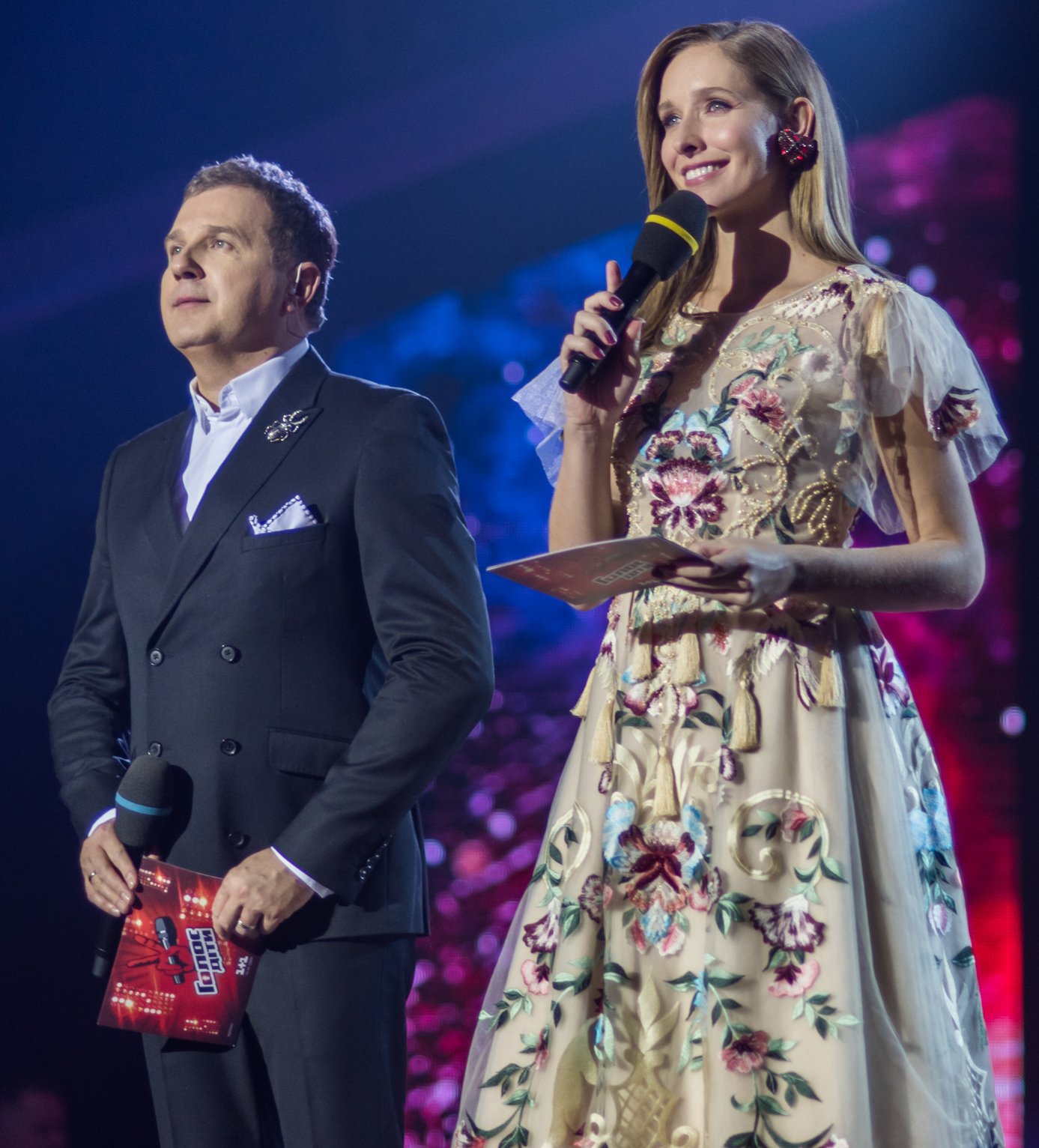
Her role in those early seasons established the pattern that would define her later work on the show. She was the host who welcomed singers, managed transitions between performances and coaching discussions, and kept the emotional temperature of the programme intelligible to viewers at home. A singing competition depends on that steadiness. Contestants arrive nervous, coaches disagree, results surprise, and the host must acknowledge emotion without letting it derail the running order. Osadcha’s background in society interviewing helped here in a less obvious way: she was accustomed to speaking to well-known people in high-pressure public settings and to moving a conversation forward without making herself the story. On Holos Krainy, the singers and coaches are the story, and the host’s skill is to make their moments legible.
Holos Krainy Presenter: Return, Continuity and Season Thirteen
After the first three seasons, Osadcha’s Holos Krainy presenting history continued in a second long stretch. Published presenter listings record her as a presenter in 2011 to 2013 and again from 2016 onwards, while her biographical summary lists her as host of The Voice of Ukraine for seasons one to three and six to eight. She has therefore been associated with the programme across more than a decade, working alongside fellow presenter Yuriy Horbunov, who has presented the show from 2015 onwards. The partnership matters to viewers because a long-running competition benefits from familiar faces. Audiences learn the hosts’ rhythms, their ways of introducing a performance, and their handling of results, and that familiarity becomes part of the show’s identity.
Season thirteen, broadcast in 2023, tested that identity in exceptional circumstances. The season was hosted by Yuriy Horbunov and Kateryna Osadcha, with coaches Ivan Klymenko, Nadya Dorofeeva, Artem Pyvovarov and Julia Sanina. It premiered on 3 September 2023 on 1+1 Ukraine and concluded on 29 October 2023. Forty contestants took part. The season is also called the European Season because it was the first season in the entire The Voice franchise to be held across Europe, a consequence of Russia’s invasion of Ukraine. The competition used a custom-designed train to Poland, and the show was staged on the set of The Voice of Poland. On 29 October, Mykhailo Panchyshyn was named winner by the public, giving Artem Pyvovarov his first win as a coach, with Yuriy Horodetskyy as runner-up. For Osadcha, the season required the same core hosting skills in unfamiliar conditions: a displaced production, an international set, and an audience watching a Ukrainian cultural institution continue under wartime pressure. The fact that the show went ahead, with its familiar hosts, was itself part of its meaning.
The Voice Kids: Presenting for Younger Singers
Osadcha’s work with the Holos format extends to its children’s edition, Holos Dity, known as The Voice Kids. The programme is a music talent show for children aged six to fourteen, based on the concept of Holos Krainy. It first broadcast on 1+1 on 4 November 2012, and it has run for five seasons. Presenting a children’s singing competition is a distinct skill from presenting the adult show. The contestants are younger, the stakes feel more personal to families watching, and the host must be warm and reassuring without being patronising. Osadcha’s presence across both versions of the format shows a range that is easy to overlook when attention focuses only on the flagship adult show.
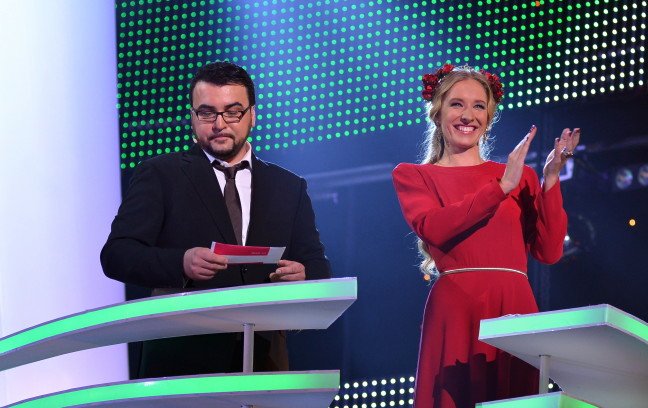
The first season illustrates the structure. It was presented by Andrii Domanskyi and Kateryna Osadcha, with coaches Tina Karol, Oleg Skrypka and Svetlana Loboda. It ran from 4 November 2012 to 6 January 2013, and Anna Tkach won, with Solomia Lukianets and Elina Sosnovskaya as runners-up. The second season, from 1 February to 1 March 2015, was presented by Osadcha and Yuri Gorbunov, with coaches Tina Karol, Potap and Natalia Mohylevska; Roman Sasanchin won, with Michael King and Anastasia Bahinska as runners-up. The fourth season, from 5 November to 17 December 2017, was again hosted by Yuri Gorbunov and Kateryna Osadcha, and Daneliya Tuleshova won. They show continuity: the same presenter returning to guide young singers through auditions, team selections and finals, season after season, while coaches changed around her. Her job remained constant even as the coaching panels and the winners changed.
Beyond the Main Stage: Model XL, Telethons and Special Hosting
In 2017, Osadcha took on a different kind of television role when she became a jury member on Model XL on 31 October 2017, alongside designer Andre Tan, choreographer Vlad Yama and Latvian model Tetyana Matskevych. The appointment closed a circle. A woman who had begun modelling at thirteen and left the profession at eighteen was now judging a modelling competition, bringing both insider knowledge and the distance of someone who had chosen another career. Her presence on the jury was not simply decorative. A former model understands what a shoot demands, what a runway walk communicates, and what happens to young people who enter the industry early, and that experience informed her judgements in a way that a presenter without that background could not replicate.
She has also been used as a host for major special broadcasts. She co-hosted the Embrace Ukraine telethon, titled Embrace Ukraine — StrivingTogether, with Timur Miroshnychenko. The event was organised by 1+1 media, the Atlas Festival and Suspilne, with partners including Vodafone, Mastercard Ukraine, Oschadbank and Dynamo Kyiv FC, and with the morning show Breakfast with 1+1 as main media partner. It was implemented with the support of Ukraine’s Ministry of Culture and Information Policy and Ministry of Foreign Affairs. A telethon host must do something different again from a competition host or a society interviewer: sustain a long broadcast, move between performances, appeals and information, and keep the purpose of the event clear without turning it into a lecture. Osadcha’s selection for the role reflects the trust placed in her as a broadcaster who can hold a large, serious live event.
Family, Partnership and the Horbunov Household
Osadcha married Yuriy Horbunov in 2017. The couple have three children, whose names and birth details are not published here to protect their privacy as minors. Her partnership with Horbunov is both personal and professional, because the two have presented Holos Krainy together for years, and audiences therefore encounter them as a presenting pair as well as a family. That dual visibility is unusual. On screen they work as colleagues with a shared understanding of the format; off screen, published anniversary coverage shows them marking family milestones together.
In February 2026, Ukrainian news agency UNN reported that Osadcha and Horbunov were celebrating their ninth wedding anniversary. Osadcha wrote on Instagram that nine years earlier they had been carefree, waiting for their child, who would be born in a few weeks, and had not suspected what trials awaited them. She added that the present moment was a time to hold on to loved ones, and that in their family that meant holding on to each other. Horbunov, in the same anniversary exchange, joked that there were few children in the family, while Osadcha replied ironically that she dreamed of new family achievements, but without increasing the family, writing that there was more to come, everything but children. The exchange is characteristic of how the couple present themselves publicly: humorous about domestic life, open about the passage of time, and careful to keep the focus on mutual support rather than on private detail.
Foundation Work: Helping Teenagers Choose a Profession
A less televised but substantial part of Osadcha’s recent public work is connected to the Kateryna Osadcha Foundation and its Platform of the Future Profession project, an initiative aimed at youth career guidance. At a career festival at VDNH, the foundation presented an interactive HUMAN CAPITAL zone for teenagers aged thirteen to eighteen, their parents and anyone interested in professional choices. The zone, covering 190 square metres near the main entrance to the festival, offered an express soft-skills test in game format with a profession passport, immersion in professional environments using virtual-reality technology, personalised advice from career consultants, guidance on how a child’s professional interests form with age and how families can support that process, and a podcast zone in which Osadcha and business representatives discussed youth employment and answered questions from visitors.
The project’s reasoning, as described by 1+1 media, responds to a mismatch in Ukraine’s labour market. Many school students feel confused about which profession to choose and tend to follow what is fashionable among peers, such as information technology, finance or the beauty industry, while the country faces a critical shortage of specialists in construction, agriculture, medicine and other industries. The Platform of the Future Profession is designed to bridge that gap by giving local employer companies and future specialists an opportunity to see and hear each other. For Osadcha, the work connects naturally to her own biography. She entered work at thirteen, changed direction at eighteen, retrained her language skills as an adult, and studied while working. A foundation that helps teenagers test their interests, rather than simply follow trends, reflects a career built on practical redirection rather than a single straight path.
Presenting Style: Direct Questions, Warmth and a Distinct Public Image
Osadcha’s presenting style can be described from the record of her programmes and interviews, rather than from general praise. In society journalism, her method has been to combine access with directness. She attends the event, observes who is present, and then asks the question that moves beyond pleasantries. In interviews she has argued that the format of Social Life allows her to cover films, theatre, political backstage life and much else, and that she feels at ease in a format that collects everything, rather than in a narrow political talk show, which she has described as not her story. That self-description is revealing. She does not present herself as a political combatant, but as a broadcaster whose programme can hold culture, society and politics in the same frame.
Her visual public image has also been a subject of interviews, including discussion of her hats, with one interview headline quoting her as saying that she feels comfortable even in the craziest hat. The point is not the headwear itself, but what it signals about her presenting persona: she is willing to be visually distinctive, to be noticed at an event, and then to use that attention to start a conversation. On Holos Krainy, by contrast, her visual presence is more restrained and functional, because the focus must remain on contestants and coaches. The ability to adjust that presence between formats, flamboyant at a society event and steady on a competition stage, is part of why she has lasted so long in Ukrainian television. Longevity in presenting is rarely about one memorable performance. It is about being reliable across formats, seasons and changing production conditions.
Why This Career Matters in Ukrainian Television
Osadcha’s career matters for reasons that go beyond any single programme. First, she represents continuity at 1+1 across a period in which Ukrainian television, society and politics changed profoundly. Social Life moved to 1+1 in August 2008 and became a long-running record of how Ukraine’s public figures presented themselves. Holos Krainy began in 2011 and, through season thirteen in 2023, continued even when its production had to move to Poland. A presenter who appears across both strands gives audiences a thread through those changes. Second, she represents a particular route into broadcasting that is not based on a traditional journalism school pipeline alone. Modelling, external examinations, adult language tuition, freelance correspondence and a history degree in absentia formed a composite education, and each element left a trace in her later work, from camera confidence to interview preparation.
Third, her career shows how Ukrainian entertainment television and public life intersect. Social Life treated politicians as society figures and asked them social questions with political consequences. Holos Krainy treated ordinary singers as public figures for the duration of a season. The Voice Kids treated children as performers who deserved serious presentation. The Embrace Ukraine telethon treated entertainment as a vehicle for solidarity. In each case, Osadcha’s role was to mediate between a stage and an audience, and to do so in Ukrainian, a language she had to work deliberately to master. She did not inherit her broadcast voice ready-made; she built it, and then used it for two decades.
Frequently Asked Questions
Is Kateryna Osadcha a coach on Holos Krainy?
No. She is a presenter and host of Holos Krainy, while singers are mentored by coaches. Her work is to introduce performances, link sections of the show, speak with contestants and coaches, and guide viewers through results. The distinction is important because coaches make team choices, whereas the host keeps the competition running and intelligible.
When and where was Kateryna Osadcha born?
She was born on 12 September 1983 in Kyiv, Ukraine. She grew up in Kyiv, took music and dance lessons as a child, and later worked abroad as a teenage model before returning to Ukraine at eighteen to pursue journalism and television.
What was Kateryna Osadcha’s first major television hosting job?
Her first major hosting step in society television came in 2005, when she passed a casting and became host of Social Life on Tonis. The programme later moved to the First National channel in 2007 and to 1+1 in August 2008, where it became closely associated with her name.
Who is Kateryna Osadcha married to?
She has been married to presenter Yuriy Horbunov since 2017, and the two have presented Holos Krainy together. They marked their ninth wedding anniversary in early 2026. The couple have three children in total.
What ages take part in The Voice Kids in Ukraine?
The children’s edition, Holos Dity, is for children aged six to fourteen. It first broadcast on 1+1 on 4 November 2012. Osadcha presented early seasons alongside Andrii Domanskyi and later alongside Yuri Gorbunov, with different coaching panels across seasons.
Did Kateryna Osadcha work as a model before television?
Yes. She began modelling at thirteen after training at the Bagira Agency’s school in Kyiv, spent three months in Tokyo at fourteen, and later worked in Germany, England and France. She ended her modelling career at eighteen and returned to Ukraine, later serving as a jury member on Model XL in 2017.
More to explore
- Yuriy Horbunov: Holos Krainy Host and Ukrainian TV Presenter
- Tina Karol Biography: Eurovision 2006, The Voice Coach, and Her Music Career
- Mykhailo Panchyshyn: Holos Krainy Season 13 Winner
- Holos Krainy Winners List: Every Winner of The Voice of Ukraine So Far
Sources
- Wikipedia – “Kateryna Osadcha”
- 1+1 Media – “Kateryna Osadcha on Holos Krainy: backstage stories from the show”
- The Day (Den), Kyiv – “‘Hopefully, there will be no politics behind the closed door anymore…’ – Interview with Kateryna Osadcha”
- Lviv Polytechnic – “Entertainment Programs on Ukrainian TV Channels” (Kitsa & Kul, 2022)